


The Character of Japanese Suit Fabrics|Discovering KUNISHIMA and Bishu
Every suit fabric has its own character.
Italian fabrics are often associated with lightness, softness, and a certain sense of elegance. British fabrics, on the other hand, are often known for their firm construction, structure, and classic character.
So what makes Japanese suit fabrics special?
One of the names we would like to introduce is KUNISHIMA, a historic textile
manufacturer based in Bishu, Aichi Prefecture.
KUNISHIMA's history goes back to 1850, when its predecessor, Kunishima Shoten, was founded.
With more than 170 years of history, KUNISHIMA is the oldest woolen textile manufacturer in the Bishu textile region.
It has been working with textiles in this region for more than 170 years.
When you think about that history, perhaps you begin to look at a piece of fabric a little differently.
KUNISHIMA is one of the fabric makers we carry at Drapper Hope, and once you have the opportunity to make a suit with its fabrics, their character becomes especially easy to appreciate.
In this article, we would like to take a closer look at what makes KUNISHIMA fabrics so interesting.
Bishu|One of Japan's Leading Textile Regions
Before talking about KUNISHIMA itself, it is worth taking a moment to understand Bishu, the textile region where the company has been based for generations.
Bishu is one of Japan's most important wool textile producing regions, centered around Ichinomiya City in Aichi Prefecture.
Spinning. Dyeing. Weaving. Finishing.
Rather than having every process carried out by a single company, Bishu has developed a unique network of specialized manufacturers, each focusing on different stages of textile production.
For many people outside Japan, the name Bishu may still be unfamiliar.
But today, the region accounts for approximately 80% of Japan's domestic wool textile production, making it one of the country's most important textile centers.
And KUNISHIMA has been making fabrics in Bishu since 1850.
Its history began before Japan entered the modern industrial era.
More than simply being an old company, this long history shows how deeply KUNISHIMA is connected to the textile culture and manufacturing network of Bishu.
Why Bishu? The Importance of Water
KUNISHIMA has been making fabrics in Bishu for more than 170 years.
But why did Bishu develop into such an important wool textile region in the first place?
One of the answers is water.
The Kiso River flows through the region, providing Bishu with an abundant supply of particularly soft water.
Water is actually an important part of wool textile production.
Wool is washed.
Yarn is dyed.
Fabric is finished.
Large amounts of water are used throughout the various stages of textile production.
Wool is particularly sensitive to the way it is processed, and the characteristics of the water can influence the final texture and finish of the fabric.
The soft water of the Kiso River has long been considered an advantage for wool textile production and is one of the natural strengths of the Bishu region. KUNISHIMA itself describes the Kiso River as having exceptionally soft water, with enough volume for industrial use.
In other words, Bishu was blessed with something fundamental to textile production:
water.
Not only is the water soft, but there is enough of it to support an entire textile industry.
More Than Water|The Strength of the Bishu Textile Region
Of course, water alone does not explain the quality of Bishu textiles.
The region is home to specialists in spinning, twisting, dyeing, weaving, and finishing.
Rather than one company doing everything, specialists with different skills work together to create a single piece of fabric.
This system of specialization and collaboration is one of the defining characteristics of Bishu.
It allows the expertise of each manufacturer to come through in everything from the choice of yarn to the dyeing, weaving, and finishing processes.
In a sense, the entire Bishu region functions like one large textile workshop.
When you look at KUNISHIMA fabrics from this perspective, they are not simply the result of one manufacturer's technology.
They are also the product of the accumulated knowledge, craftsmanship, infrastructure, and environment of the Bishu textile region itself.
That is part of what makes Japanese textiles so interesting.
The First Impression of KUNISHIMA Fabric

When you first touch a KUNISHIMA fabric, one of the first things you may notice is its substantial feel.
Compared with many standard wool fabrics, KUNISHIMA uses a higher number of warp and weft threads, creating a dense weave with a strong sense of structure.
The result is a fabric with body, resilience, and a distinctive firmness.
But it is not simply stiff.
When you actually touch it, there is also a certain softness and smoothness.
I think this combination of structure and softness is one of the most interesting characteristics of KUNISHIMA fabrics.
They look structured and formal.
But when you put on a suit made from them, they do not necessarily feel rigid or uncomfortable.
When explaining KUNISHIMA fabrics, I sometimes describe them this way:
“Structured in appearance, but not restrictive to wear.”
KUNISHIMA itself describes its fabrics as combining a substantial, high-density texture with pliability and a strong sense of resilience.

Why Do KUNISHIMA Fabrics Have Such a Strong Structure?
One of the reasons is fabric density.
A woven fabric is created by crossing warp and weft yarns.
The number of yarns used and the way they are woven have a significant effect on the appearance, strength, drape, and overall character of the fabric.
KUNISHIMA is known for using a higher thread count than ordinary wool fabrics and creating densely woven cloth.
As a result, the fabric has a certain strength of its own.
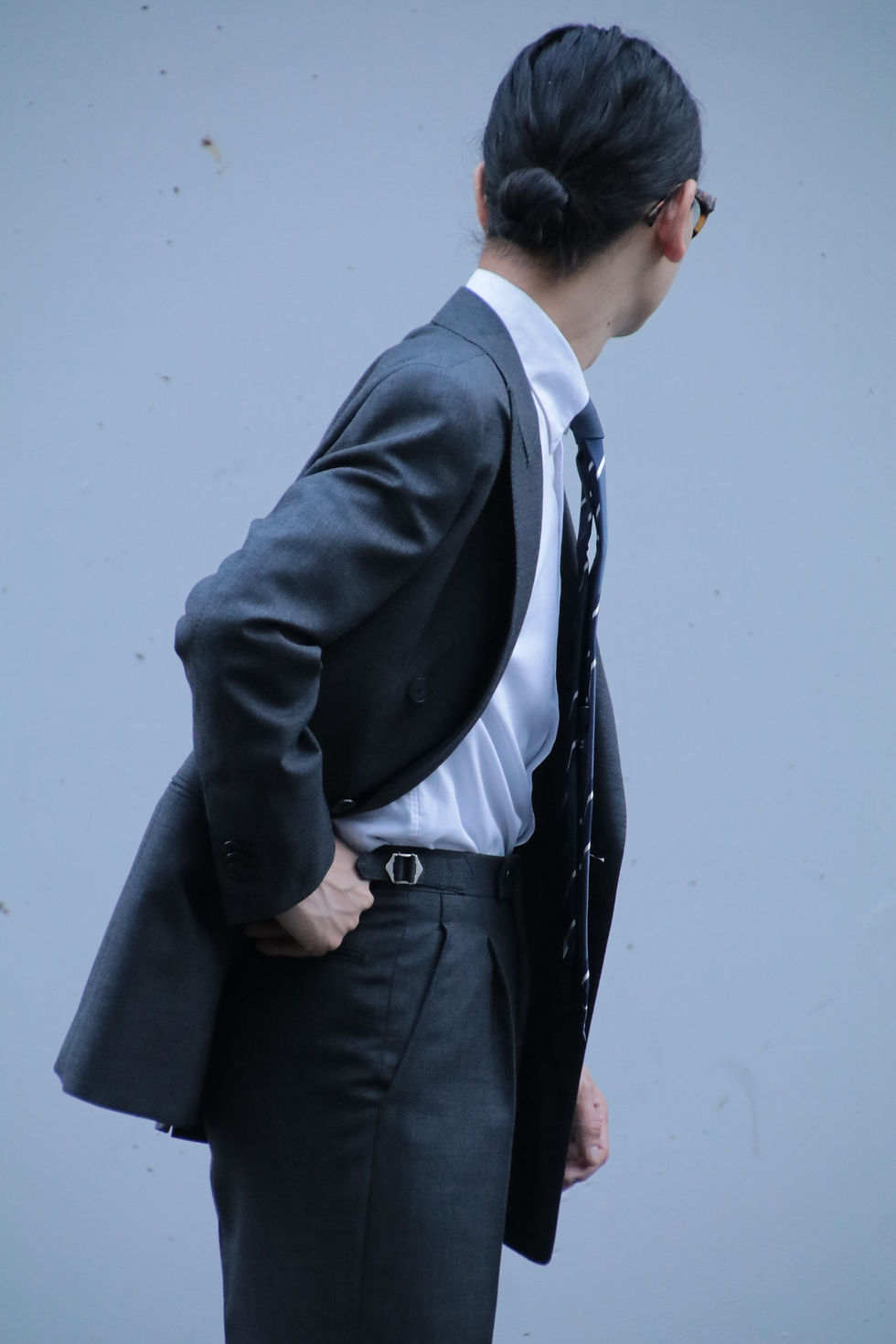
When it is made into a jacket or suit, that character can be seen in the silhouette.
The three-dimensional shape around the shoulders and chest.
The way the lapel rolls.
The way the crease of the trousers holds its line.
These details can stand beautifully, creating the structured appearance we often associate with traditional tailoring.
A suit is made to fit the body.
But at the same time, it is also a garment in which the fabric itself helps create the shape.
Once you think about it this way, the structure and resilience of a fabric are not simply matters of touch or comfort.
They are part of what gives a suit its character.

Projectile Looms and High-Density Fabrics
Another interesting aspect of KUNISHIMA's manufacturing is its use of projectile looms.
This may be getting a little technical, but there are many different types of weaving machines, each suited to different kinds of fabrics.
KUNISHIMA uses projectile weaving technology as part of its production, allowing it to create dense, structured fabrics.
What I find interesting here is that the story is not simply about “traditional looms being better.”
The important question is:
What kind of fabric are you trying to make?
What kind of texture do you want?
And what kind of suit will the fabric eventually become?
The appropriate technology should be chosen according to the desired result.
KUNISHIMA has a long history, but it is not simply preserving old techniques for the sake of tradition.
Instead, its accumulated knowledge continues to be used as part of modern textile production.
I think that is one of the things that makes KUNISHIMA such an interesting manufacturer.
The Appeal of Made in Japan
When speaking with customers from overseas, we often hear that they are interested in Japanese craftsmanship.
Japan is known around the world for many forms of manufacturing and craftsmanship:
watches, automobiles, ceramics, furniture, and many others.
Textiles are another part of that story.
At the same time, Japanese textiles may still be relatively unknown outside Japan compared with their Italian or British counterparts.
That is why we believe places like Bishu are worth discovering.
A textile region with a history stretching back generations.
And a manufacturer that has been making fabrics there since 1850.
For us, these are part of what makes having a suit made in Japan interesting.
If you are visiting Japan and considering having a made-to-measure suit made here, we hope you will take the opportunity to experience Japanese fabrics as well as Italian and British ones.
Choosing a Japanese fabric is another way of experiencing Made in Japan tailoring.
Classic, But Not Rigi
There is something distinctly classic about KUNISHIMA fabrics.
A firm structure.
A comfortable sense of weight.
A silhouette that holds its shape beautifully.
These qualities work especially well with classic tailoring.
At the same time, when you actually wear a suit made from KUNISHIMA fabric, it can feel quite different from the image of an old-fashioned, heavy and rigid suit.
Because the fabric has enough body and resilience, it can maintain the shape of the suit without simply clinging to the body.
This is where I think the balance comes from:
A structured appearance, without a restrictive feeling.
Wearing a classic suit today does not necessarily mean reproducing the clothes of the past exactly as they were.
What matters is whether the suit can live naturally within modern life.
Whether you can wear it comfortably.
And whether it is something you will still want to wear years from now.
KUNISHIMA fabrics have qualities that work beautifully with this kind of contemporary approach to tailoring.
Experience Japanese Suit Fabric for Yourself
The character of a fabric is difficult to fully understand from photographs alone.
Even two navy fabrics can feel completely different when you touch them.
Their softness.
Their resilience.
The way they respond to light.
The way the surface changes as the fabric moves.
Especially with fabrics like KUNISHIMA, where structure and resilience are such important characteristics, the difference becomes much easier to appreciate when you actually hold the fabric in your hands.
At Drapper Hope, we offer a wide selection of fabrics, including KUNISHIMA and other Japanese textiles from Bishu, as well as fabrics from Italy, the United Kingdom, and other regions.
There is no single fabric that is “the best.”
It depends on what kind of suit you want to wear.
Where you plan to wear it.
And what kind of atmosphere you are drawn to.
Finding a fabric that suits the person wearing it is part of what makes made-to-measure tailoring so enjoyable.
For customers visiting Japan from overseas, we especially hope you will take the opportunity to experience Japanese textiles for yourself.
If you are having a suit made in Japan, why not try a Japanese fabric as well?
It may be one of the most enjoyable parts of the experience.
At Drapper Hope, we offer a wide selection of fabrics, including KUNISHIMA, Japanese fabrics from Bishu, and fabrics from Italy and the United Kingdom.
You do not need to know anything about fabrics before you visit us.
Simply look at them, touch them, compare them, and take your time finding the fabric that feels right for you.


コメント